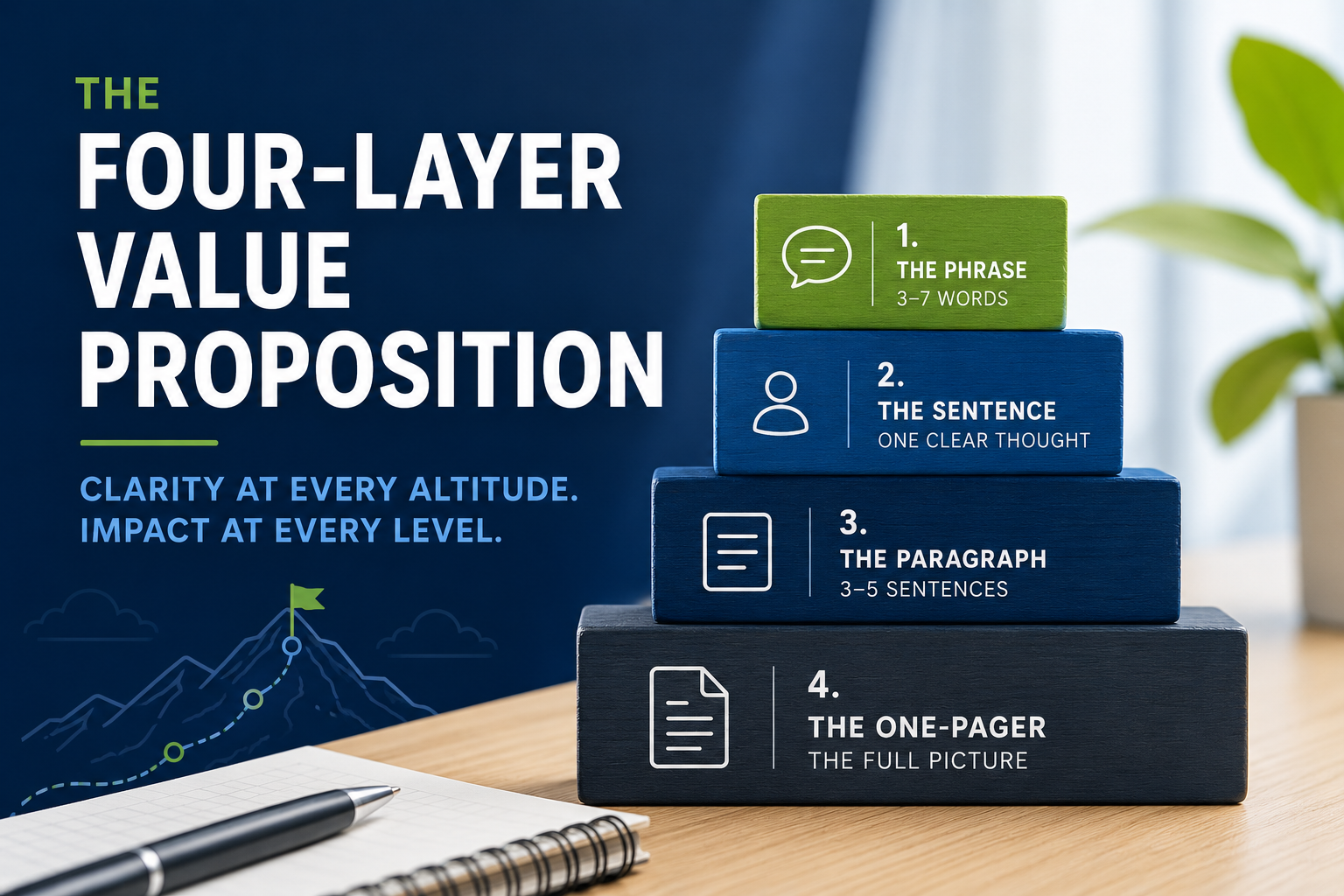
The Four-Layer Value Proposition: A Must-Have Content Tool for Every Founder

By Terry Chapman, Founder & CEO, Start Up Partners
Founder and CEO of Start Up Partners, a venture studio in Birmingham, Alabama. Decades building technology ventures across medical imaging, data analytics, marketplaces, and medical devices.
Published by Start Up Partners | sup.ventures
One of the first things I ask every founder who walks through our door at Start Up Partners is simple: "Tell me what your company does." What happens next is usually revealing.
Some people launch into a ten-minute technical deep-dive. Others stumble, restart, and eventually land somewhere useful. A rare few nail it in a single, clear sentence.
That ability — to explain your value quickly and confidently, at any altitude — isn't a natural gift. It's a tool you build. And one of the most practical tools I recommend to every innovator and founder in our portfolio is what I call the Four-Layer Value Proposition.
What Is a Value Proposition, Really?
Your value proposition is the core answer to the most important question your business faces: Why should someone choose you? It captures the problem you solve, who you solve it for, and why your solution is the right one.
The mistake most founders make is thinking they only need one version of that answer. In reality, you need the same answer told at four different lengths — because different situations demand different depths.
The Four Layers
1. The Phrase (3–7 words)
This is your tagline — the version so tight it could fit on a business card, a social media bio, or the header of your website. It's not a slogan for its own sake; it's a distillation of your core promise.
Think of it as the thing someone says about you when they refer you to a friend.
2. The Sentence (one clear, complete thought)
This is your elevator-door version — the one you deliver when someone asks what you do and you have about fifteen seconds. It names who you serve, what problem you solve, and what makes your approach different.
Think of it as your answer when someone asks at a networking event.
3. The Paragraph (3–5 sentences)
Now you have room to breathe. This version adds context: the scope of the problem, your solution mechanism, and a proof point or differentiator. It's ideal for your website's About section, a LinkedIn company summary, or the opening of a pitch deck.
Think of it as the first thing an investor reads before deciding if they want a meeting.
4. The One-Pager
This is your full picture — the version that earns a real decision. It covers the problem in depth, your solution, your target customer, your business model, your traction, and your ask. It works as a leave-behind after a meeting, an investor summary document, or a grant application narrative.
Think of it as the document that does the work while you're not in the room.
Why This Approach Works
Building all four layers does more than give you ready-made content. It forces you to understand your own business at every level of detail — and to find the words that hold up at every altitude.
When you can move fluidly between a phrase and a one-pager, you signal to investors, customers, and partners that you understand what you're building and why it matters. That kind of clarity is rare, and it's one of the clearest signals of a founder who is ready for what comes next.
Start Building Yours
Here's a simple exercise to put this into practice:
- 1Set a timer and draft each layer from scratch, in order, starting with the phrase.
- 2Don't overthink the first pass — just get words on the page.
- 3Share the drafts with someone outside your industry and see which parts require explanation.
Wherever you have to clarify, you have work to do.
At Start Up Partners, we work with founders across Alabama's STEM ecosystem to develop exactly this kind of foundational clarity. If you're an early-stage founder who wants help building your value proposition stack — or any of the other tools that make early traction possible — we'd love to hear from you.